So you've landed the job offer. That's a huge win, and you should absolutely take a moment to celebrate. But once the initial excitement settles, the real work begins. This next phase isn't just about saying ‘yes’—it’s about making a deliberate, strategic career move that sets you up for the long haul.
It's tempting to accept an exciting offer on the spot, but rushing this decision can lead to overlooking critical details that could sour the experience later. This guide will walk you through a clear, actionable framework for evaluating, negotiating, and formally accepting an offer, tailored specifically for the competitive tech and startup world.
This process is more than a formality; it's your first opportunity to showcase your professionalism and attention to detail to your new employer.
Actionable Tip: Before you even think about how to accept a job offer, you need to be certain it's the right one. Take 30 minutes to write down your non-negotiables for a new role. Think about culture, growth, expectations, and compensation. Then, grade the offer against your list. This simple exercise provides the clarity you need to move forward.
The Modern Job Offer Landscape
Gone are the days when a job offer was just a salary figure on a piece of paper. Today's market, especially in tech and for startups, is way more complex. You'll likely see a mix of compensation elements that all need careful consideration.
- Equity and Stock Options: Startups often use equity to attract talent when they can't compete with Big Tech salaries. But the real value is tied to the company's future performance. You need to get comfortable with terms like vesting schedules and strike prices to know what you're actually getting.
- Performance Bonuses: These can be a nice boost to your total compensation, but they’re often tied to specific individual or company goals. For example, a bonus might be structured as "up to 15% of base salary, based 70% on company revenue targets and 30% on meeting individual MBOs." It's crucial to clarify exactly how these are measured and when they're paid out.
- Flexible Work Arrangements: A remote or hybrid policy can be a game-changer for your work-life balance, but the devil is in the details. For instance, does "hybrid" mean two fixed days in the office, or is it a flexible "come in when you need to" policy? The specifics can vary wildly from one company to another, so you need to know what you're signing up for.
Moving Forward with Confidence
We'll walk you through how to decode every line of your compensation package, negotiate with confidence, and handle the transition like a pro. Think of this as your roadmap—not just for accepting an offer, but for making sure it's the right one.
Getting this right from the start sets the stage for your success from day one. To kick things off, check out this helpful list of questions to ask before accepting a job offer. It will give you the clarity you need to move forward.
Decoding Your Startup Compensation Package
A startup job offer is rarely just a number on a page. It's a complex blend of immediate rewards and long-term potential, and figuring out its true value means looking way beyond the base salary. Before you can confidently say "yes," you need to dissect every component to see the full financial picture.
This isn't just about the money, either. It’s about making sure the offer lines up with your personal financial goals and how much risk you're comfortable with. Startups are, by their very nature, high-risk, high-reward environments, and you'll see that reflected in how they build their compensation packages.
The current tech hiring landscape really drives this point home. Recent data shows that tech hiring rates have stabilized at around 29% in 2025, a noticeable dip from the 34% we saw back in 2023. This is especially true for startups. Early-stage firms, which were once hiring at a blistering 49% rate, are now much more in line with mature companies, hovering between 27-30%. This tells us they're focused on building efficient, high-impact teams—making your compensation package a critical sign of how much they value your role.
This visual map breaks down the journey from getting the offer to making your final call.
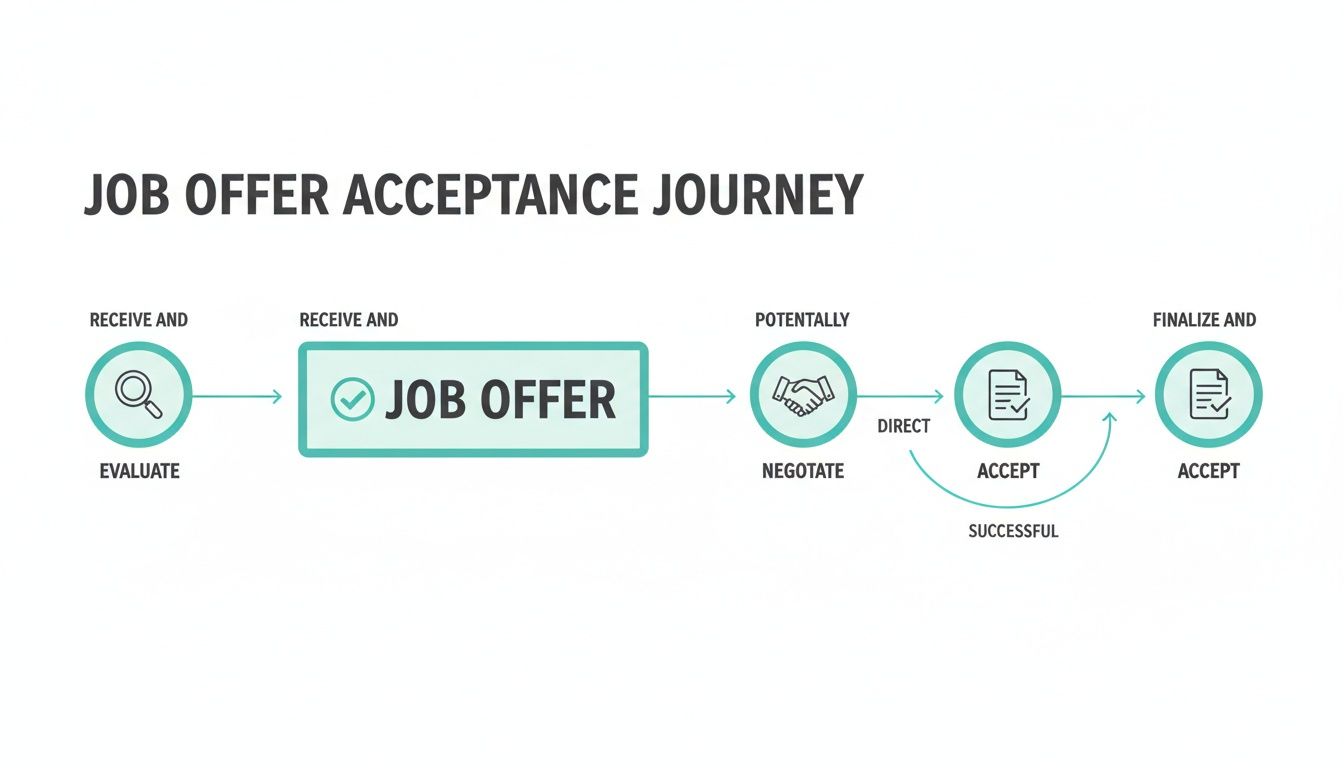
As you can see, a confident "yes" doesn't just happen. It’s the result of a deliberate process that starts with careful evaluation and, more often than not, involves a bit of negotiation.
Beyond the Base Salary: Understanding Equity
For most people considering a startup role, equity is the most exciting—and confusing—part of the offer. It’s your slice of ownership in the company, with its value tied directly to whether the company succeeds or fails. Getting your head around the mechanics is non-negotiable.
You'll typically run into two common forms of equity:
- Stock Options (ISOs & NSOs): These give you the right to buy a certain number of company shares at a predetermined price, known as the strike price or exercise price. The whole game is for the company's valuation to shoot up, making your shares worth a lot more than what you paid to get them.
- Restricted Stock Units (RSUs): Think of these as a promise of company shares that you'll receive later on, usually after hitting certain vesting milestones. Unlike options, you don't buy them; they're granted to you directly, which usually makes the tax situation a bit more straightforward.
Your equity is almost always tied to a vesting schedule. This is just a timeline that dictates when you actually earn full ownership of your shares. A classic schedule is four years with a one-year "cliff." This means you get absolutely nothing until you hit your first anniversary. After that, 25% of your grant vests, and the rest typically vests monthly or quarterly from there.
The one-year cliff is a massive milestone. If you leave the company before that first anniversary—for any reason—you walk away with zero equity, no matter how much you contributed.
Essential Questions to Ask About Your Equity Grant
Just knowing the number of options or RSUs you're offered is pretty much meaningless without more context. To figure out what your equity could actually be worth, you need to dig for more information. Don't be afraid to ask these questions.
- What is the strike price of my options?
- What was the company's last 409A valuation, and when was it done?
- How many total shares are currently outstanding?
- What percentage of the company does my grant actually represent?
With these data points, you can start to estimate the "paper value" of your grant. For instance, if you're offered 10,000 options in a company with 10 million shares outstanding, you own 0.1% of the company. Understanding these numbers is the first step to truly evaluating what's on the table. For a deeper dive, check out our guide on startup equity basics for job seekers.
Evaluating the Complete Benefits Package
While equity holds the promise of a future payday, your benefits package impacts your daily life and wallet right now. A strong benefits package can easily be worth thousands of dollars a year, so it deserves just as much attention as your salary.
Look for perks that genuinely support your lifestyle and career. A generous professional development fund can be a game-changer for leveling up your skills, while a flexible remote policy might save you a ton of time and money on commuting. The quality of the health insurance is another huge one—low premiums look great, but not if the deductible is so sky-high that you can't actually afford to use it. Make sure you see the whole picture.
To help you stay organized, here's a checklist to systematically break down a startup offer.
Startup Offer Evaluation Checklist
This checklist is designed to help you methodically review each part of a startup job offer. By asking the right questions and knowing what to look out for, you can make a much more informed decision and avoid any unwelcome surprises down the road.
| Component | Key Questions to Ask | Red Flags to Watch For |
|---|---|---|
| Base Salary | Is this competitive for my role, experience, and location? How does it compare to market data from sites like Levels.fyi or Glassdoor? When are performance and salary reviews conducted? | A salary significantly below market rate without a compelling equity upside. Vague answers about salary review cycles. |
| Equity | What percentage of the company does this grant represent? What is the vesting schedule (e.g., 4-year with 1-year cliff)? Is there an option for early exercise? What happens to my vested options if I leave? | Unwillingness to share the total number of outstanding shares. An unusually long vesting schedule (> 4 years) or cliff (> 1 year). A very short post-termination exercise window (e.g., 90 days). |
| Bonus | Is there a performance bonus? How is it structured (company vs. individual performance)? What has the historical payout been for this role? Is it guaranteed or discretionary? | A bonus structure that is entirely discretionary with no clear targets. Claims of high bonus potential without historical data to back it up. |
| Health & Wellness | What are the monthly premiums, deductibles, and out-of-pocket maximums? Does the plan cover dental, vision, and mental health? Are there any wellness stipends (e.g., for a gym)? | High-deductible plans that make the insurance difficult to use. Lack of comprehensive mental health support. Minimal employer contribution to premiums. |
| Time Off & Flexibility | What is the paid time off (PTO) policy? Is it accrued or unlimited? What is the policy on sick days and holidays? What are the expectations for remote, hybrid, or in-office work? | "Unlimited PTO" policies that, in practice, discourage employees from taking time off. Pressure to be "always on" despite stated flexible work policies. |
| Professional Development | Is there an annual budget for conferences, courses, or certifications? Are there internal mentorship programs or opportunities for growth? | No dedicated budget or formal support for learning and development. Vague promises of "growth opportunities" with no clear career pathing. |
| Retirement | Is there a 401(k) plan? Does the company offer a match? If so, what is the matching percentage and when does it vest? | No 401(k) plan offered, or a plan with no company match. A long vesting period for the company match. |
Using a structured approach like this ensures you don't overlook any crucial details. A great offer is about more than just one big number; it's about the total value and how well it aligns with what you need for your career and life.
Mastering the Art of Smart Negotiation
Let’s get one thing straight: negotiation isn't a confrontation. It’s a conversation about your value, and in the startup and tech world, it's pretty much expected. Many candidates hesitate, worried they’ll come off as difficult. But a well-reasoned negotiation shows you know your worth and can advocate for yourself—two qualities any good employer wants.
Think about it from their side. The company has already sunk a ton of time and resources into recruiting you. They picked you. At this point, they’re invested and ready to get you on board. That gives you the leverage you need to open a dialogue and land on an agreement that makes everyone happy.

The job market is also on your side. In the competitive 2025 tech scene, new hires are juggling an average of 3.5 job offers at a time, a big jump from just 2.3 offers the previous quarter. This shift means job seekers, especially in high-demand roles like software development, have more power than ever. You can dig into more of the trends shaping the job market if you're curious.
Building Your Case with Data
Before you even think about asking for a dime more, you need to do your homework. A solid, evidence-based case is what separates a smooth negotiation from an awkward one. Your argument needs to stand on three pillars.
- Market Data: Jump on sites like Levels.fyi and Glassdoor. Look for similar roles at companies of a comparable size and stage in your specific location. Actionable step: Create a simple spreadsheet with 3-5 comparable roles, their salary ranges, and the source. This gives you a concrete data set to reference.
- Your Unique Value: This is where you connect the dots for them. Remind them of specific moments from your interviews where your skills perfectly matched their needs. For example, you could say, "During the interview, we discussed the need to improve system latency. My experience reducing P99 latency by 40% at my previous role directly addresses that challenge." It’s a direct justification for your ask.
- Interview Performance: Did you get great feedback during the process? If the team was clearly excited about you, that’s a powerful signal. You can subtly reference this by saying something like, "I really enjoyed my conversation with the engineering team, and it sounds like my skills are a strong match for their upcoming projects."
Crafting Your Negotiation Request
Once you've got your data lined up, it's time to frame your request. Always, always start by expressing genuine excitement for the role and the company. Kicking things off on a positive note makes the whole conversation feel collaborative, not adversarial.
Be specific and confident in your ask. Vague phrases like "I was hoping for a bit more" just don't cut it. You need to present a clear, data-backed counteroffer.
Pro Tip: Frame your request as a question about flexibility rather than a demand. For example, "Is there any flexibility in the compensation?" is a softer opening than "I need X salary."
Here’s a practical example of how you could phrase a salary negotiation over email:
- "Thank you so much for the offer! I am genuinely thrilled about the opportunity to join the team and contribute to [Company's Mission]. Based on my research for a [Your Role] with my experience in [Your Location], the market rate is closer to the [Your Target Salary Range] range. Given my specific experience in [Mention a Key Skill/Accomplishment], would it be possible to adjust the base salary to [Your Specific Ask]?"
This script is respectful, backed by data, and directly ties your value to what you're asking for.
Navigating the Dreaded Counteroffer
Just when you’re ready to sign on the dotted line, your current boss might slide a counteroffer across your desk. It’s flattering, for sure—they don't want to lose you! But be careful. Accepting a counteroffer is usually just a short-term fix for a much bigger problem.
Think about it: why did you start looking for a new job in the first place? Whether it was the culture, a lack of growth, or weak leadership, those issues rarely vanish just because your paycheck gets a bump. In fact, statistics show that a huge percentage of employees who accept a counteroffer are gone within 12 months anyway.
And there's the awkward aftermath. The company didn't recognize your full value until you had one foot out the door. This can change the dynamic, and you might find yourself sidelined when it comes to future promotions or high-profile projects.
Here’s how to turn down a counteroffer gracefully while keeping your professional relationship intact:
- "I sincerely appreciate you putting this offer together. It means a lot to me that you value my contributions here. However, I have made my decision based on a new opportunity that aligns more closely with my long-term career goals. My last day will be [Your Last Day], and I am committed to ensuring a smooth transition."
This response is firm, appreciative, and professional. It shuts down any further negotiation without burning bridges—something you always want to avoid. Your network is too valuable for that.
Sealing the Deal: How to Write Your Acceptance Email
You’ve navigated the compensation details, gone back and forth on negotiations, and finally landed on a decision. It’s time to make it official. Sending a clear, professional acceptance email is that final, critical step to formally lock in the job offer and kick off your new role on the right foot.
Think of this email as more than just a simple "yes." It's the written record of your agreement, confirming all the key terms you’ve discussed so there are no surprises later. It’s also your very first piece of communication as a soon-to-be member of the team, so it’s your chance to set a great, positive tone from the get-go.
Taking this final step with confidence is becoming more and more common. Offer acceptance rates actually climbed to 84% in 2025, which is up from 81% during the height of the Great Resignation. This little shift suggests that tech and startup folks are being much more decisive when they find an opportunity that truly fits. You can get more details on this trend in Gem's 2025 Recruiting Benchmarks Report.
Breaking Down a Strong Acceptance Email
Your acceptance email needs to walk a fine line—it should be concise but also cover all the important details. You're aiming for a mix of genuine excitement and professional clarity. Think of it as having three essential parts that formalize your new role.
Here's what you absolutely need to include:
- A No-Nonsense Subject Line: Don't make the hiring manager hunt for your email. Something direct and easy to search like "Job Offer Acceptance – [Your Full Name]" works perfectly.
- Real Enthusiasm and Thanks: Always start on a high note. A simple, sincere line expressing your excitement and thanking them for the offer goes a long way.
- Confirmation of the Key Terms: This is the most important part. You need to clearly restate the essentials you’ve agreed on: your exact job title, the final salary, and your official start date.
- A Proactive Closing: End by asking what’s next. This shows you’re ready to jump in and tackle any paperwork or onboarding tasks they need from you.
Real-World Examples for Any Situation
The tone of your email will naturally shift a bit depending on how the offer process played out. A straightforward acceptance after getting the perfect offer is going to read differently than one that comes after a bit of negotiation.
Here are a couple of practical examples you can tweak to fit your own situation.
Example 1: The Straightforward Acceptance
This one is perfect for when the offer was exactly what you wanted right out of the gate, no negotiation required. It's clean, professional, and gets straight to the point.
Subject: Job Offer Acceptance – Jane Doe
Body:
Hi [Hiring Manager's Name],Thank you so much for offering me the Senior Software Engineer position at [Company Name]. I am thrilled to formally accept the offer and am very excited to join the team.
As we discussed, my start date will be [Start Date], with an annual salary of [Salary].
Please let me know if there is any paperwork or other information you need from me before then. I look forward to contributing to the team!
Best regards,
Jane Doe
Example 2: Accepting After a Negotiation
If you went through a successful negotiation, it’s crucial that your acceptance email clearly confirms those updated terms. This creates a paper trail of the final agreement, which is exactly what you want.
Subject: Job Offer Acceptance – John Smith
Body:
Hi [Hiring Manager's Name],Thank you again for your time on the phone earlier. I am delighted to officially accept the negotiated offer for the Product Manager role.
To confirm, the agreed-upon terms are a starting salary of [Negotiated Salary] and an additional [Number] of stock options, with a start date of [Start Date].
I truly appreciate you working with me on this and am eager to get started. Let me know what the next steps are.
All the best,
John Smith
Managing Your Resignation and First 90 Days
Once you've signed that offer letter, the real work begins. This next phase is a delicate dance between two crucial periods: making a graceful exit from your current job and hitting the ground running in your new one. How you manage your resignation and your first three months will define your professional reputation for years to come.
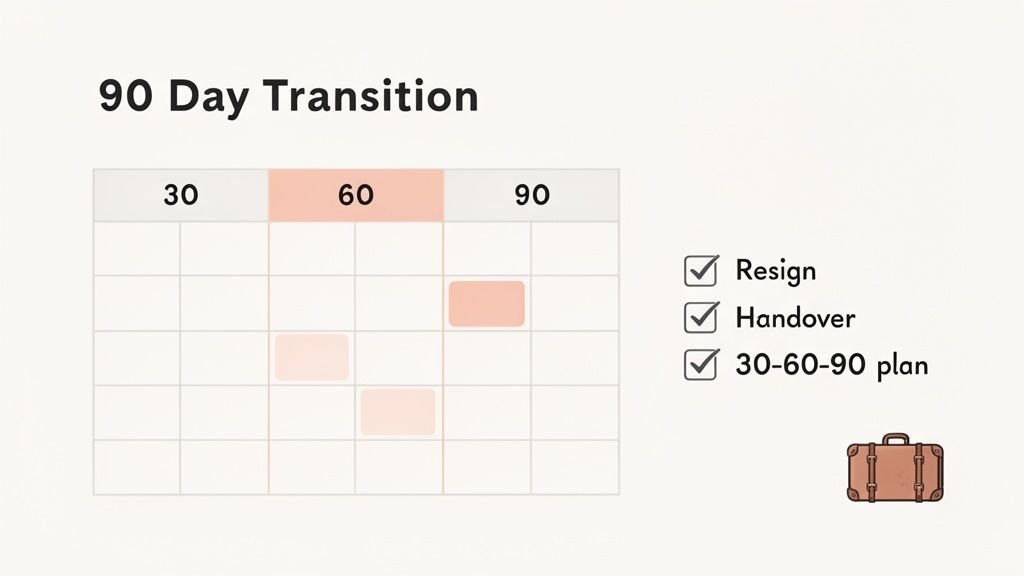
Leaving on good terms is every bit as important as starting on the right foot. A smooth, professional departure keeps your network intact and leaves behind a final impression of competence and class.
A Checklist for a Professional Resignation
Putting in your notice is almost always awkward. But having a clear plan makes it far less stressful. The goal here is to be direct, professional, and helpful, setting your team up for success after you’re gone.
- Schedule a Private Meeting: Don't drop the news over Slack or email. Ask your manager for a quick, private chat. Practical script: "Hi [Manager's Name], do you have 15 minutes to chat privately this afternoon? I have an update I'd like to share."
- Keep it Short and Sweet: State your intention to resign and confirm your last day. There's no need for a long explanation. Something as simple as, "I've accepted an opportunity that's a better fit for my long-term career goals," is perfect.
- Follow Up in Writing: After your chat, send a formal resignation letter via email. This creates the official paper trail for HR. For some great templates and tips, check out our guide on what to write on a two-week notice.
- Create a Handover Plan: Don't wait to be asked. Proactively create a document outlining the status of your projects, key contacts, and where to find important files. This small step makes the transition significantly smoother for your team.
Your last impression is a lasting one. Resist the urge to "check out" during your final two weeks. How you manage your exit speaks volumes about your work ethic and character, and people in your industry will remember it.
Building Momentum with a 30-60-90 Day Plan
Walking into a new role, especially at a fast-paced startup, can feel like drinking from a firehose. A 30-60-90 day plan is your secret weapon. It’s not just a to-do list; it's your roadmap for learning the ropes, making an impact, and building connections.
Your main goal in the first 90 days is to become a trusted, valued member of the team. Bringing a plan to the table shows your new manager you’re serious about hitting the ground running.
Your First 30 Days: Learn and Listen
Your first month is for soaking it all in. Think of yourself as a sponge. Your objective is to understand the company culture, the unwritten rules, and the key players before you even think about making changes.
- Map Out Key Stakeholders: Identify the 5-10 people crucial to your role's success. Set up 15-minute intro chats with each and ask them, "What does success in my role look like from your perspective?"
- Decode Team Dynamics: Pay close attention in meetings. Who speaks first? Who asks the hard questions? How are decisions really made? This context is invaluable.
- Align on Expectations: Sit down with your manager in week one. Ask them directly: "What is the most important thing I can accomplish in my first 30 days?" Don't leave this to guesswork.
Your Next 60-90 Days: Contribute and Optimize
Now that you have the lay of the land, you can start shifting from learning mode to doing mode. The focus moves to actively contributing and spotting opportunities for small, meaningful improvements.
- Snag an Early Win: Look for a manageable project or a nagging problem you can solve. Delivering a quick, tangible result is the fastest way to build credibility.
- Ask for Feedback: At the 45-day mark, proactively ask your manager, "Is there anything you've seen so far that you'd like me to do more of or less of?" This shows you're committed to adapting and growing.
- Start Making Your Mark: With context and trust built, you can now start suggesting small process tweaks or new ideas. Frame them as experiments: "I have an idea for improving our standup format. Could we try it for a week and see how it feels?"
Navigating Other Offers and Rejections
Once you’ve officially accepted an offer, there’s one last piece of business to take care of: letting the other companies know you’re off the market. Juggling multiple opportunities is pretty common, especially for in-demand tech roles. How you decline those other offers says a lot about you.
It’s a small world out there, and the tech community is even smaller. You never know—the hiring manager you turn down today might be at your dream company tomorrow. Handling this step with class is a sign of professional maturity and helps you keep your reputation solid. The goal is to keep doors open for the future, not slam them shut.
The Art of the Graceful Rejection
Turning down a job offer can feel a little awkward, but a clear, respectful approach makes all the difference. The key is to be appreciative, direct, and brief. No need for a five-paragraph essay or a super apologetic tone.
If you’ve built a great rapport with the recruiter or hiring manager, a quick phone call can be a nice personal touch. That said, an email is perfectly fine and often preferred, since it gives them a written record for their internal systems.
Actionable Tip: Update your personal CRM or spreadsheet where you've been tracking your job applications. Note that you've declined the offer but had a positive experience. This helps you remember key contacts and positive interactions for future networking.
Practical Email Examples for Declining an Offer
Your rejection email should always be customized a bit, but it needs to hit three key points: a genuine thank you, a clear statement that you're declining, and well wishes for their search.
Here are a couple of real-world examples you can tweak to fit your situation.
Example 1: The Standard Professional Rejection
This one is your go-to for most situations. It's polite, professional, and gets straight to the point without burning any bridges.
Subject: Job Offer – [Your Full Name]
Body:
Hi [Hiring Manager's Name],Thank you so much for offering me the [Job Title] position at [Company Name]. I sincerely appreciate you taking the time to speak with me and share more about this exciting opportunity.
After careful consideration, I have decided to accept another role that aligns more closely with my current career goals. This wasn't an easy decision, as I was truly impressed with your team and mission.
I wish you and [Company Name] all the best in finding a suitable candidate. Thank you again for your time.
Best regards,
[Your Full Name]
This approach is gracious and leaves the relationship on a high note. It gives a simple reason without getting into the weeds about the other offer—which is always a good move professionally. You just never know when your paths might cross again.
Job Offer FAQs
It's completely normal to have a few lingering questions as you wrap up your job search. Even after you’ve made your decision, some tricky situations can pop up. Let's walk through a few common scenarios.
What if the Written Offer Is Different from the Verbal One?
This happens more often than you'd think. Nine times out of ten, it’s an honest mistake—a typo from HR or a miscommunication—not a sneaky bait-and-switch.
If you spot a discrepancy in the salary, title, or start date, bring it up right away. A friendly, professional email is all it takes to get things sorted out.
Practical Script: "Hi [Hiring Manager's Name], thanks again for sending this over. I noticed the salary listed is [Amount in Written Offer], but we had discussed [Amount in Verbal Offer]. Could you please clarify this? I'm very excited to get started and just want to ensure we're aligned."
This approach is non-confrontational and gives them an easy way to correct the error without any friction. Whatever you do, never sign an offer that doesn’t accurately reflect your agreement.
Can I Rescind My Acceptance if a Better Offer Comes Along?
Technically, yes, you can. Most employment in the U.S. is "at-will," meaning either party can terminate the relationship at any time. But just because you can doesn't always mean you should.
Backing out of an acceptance can burn bridges, and the tech and startup worlds are surprisingly small. Word gets around. Damaging your professional reputation just isn't worth it if you can avoid it.
If you find yourself in an unavoidable situation where you must rescind, handle it with care. A direct, apologetic phone call is much better than an email. Explain the situation briefly and professionally, but brace yourself for a tough conversation.
How Much Time Do I Have to Accept an Offer?
There's no universal deadline, but most companies will expect a decision within a few business days up to a week. If there's a hard expiration date, they'll make it clear in the offer letter.
Need a little more time to weigh your options? It’s perfectly fine to ask. Just be transparent about why.
For instance, you could say, "I'm expecting to make a final decision by Friday. Would it be possible to have until then to review everything?" Most employers are reasonable and will appreciate the clear communication.
Ready to stop searching and start getting noticed by top startups? Underdog.io flips the script by bringing curated opportunities directly to you. Sign up in 60 seconds and let high-growth tech companies apply to you. Find your next great role at Underdog.io.